On Sunday 8 March in the sermon I mentioned some of the reporting coming out of the United States of hundreds of complaints within the armed services of the way military commanders are utilising religious, biblical and theological rhetoric. Independent journalist Jonathan Larsen reported as part of his Substack:
A combat-unit commander told non-commissioned officers at a briefing [on] Monday that the Iran war is part of God’s plan and that Pres. Donald Trump was “anointed by Jesus to light the signal fire in Iran to cause Armageddon and mark his return to Earth.”
[An] NCO wrote to the Military Religious Freedom Foundation that their commander “urged us to tell our troops that this was ‘all part of God’s divine plan’ and he specifically referenced numerous citations out of the Book of Revelation referring to Armageddon and the imminent return of Jesus Christ.”
Last year as part of my reading around the growth of Christian Nationalism, and particularly to understand better what is going in the United Kingdom (as you can imagine there are many books about it from an American perspective, of which I have read more than a few), I read a book recommended to me by a staff member in the central Church of Scotland offices. The book is titled "The Church, The Far Right, And The Claim To Christianity" edited by Rev Dr Helen Paynter and Maria Power. Paynter is the Executive Director of the Centre for the Study of Bible and Violence based out of Bristol Baptist College. She is very worth reading or listening to.
Today I saw she had written an excellent piece that would make a very good follow up to my brief comments during the sermon. She titles it "Armageddon, the bombing of Iran, and the irresponsible use of Revelation".
She starts...
This is the first of what I hope will be a handful of rapid-response blogs to speak into the inflammatory and dangerous rhetoric of ‘Armageddon’ and ‘End Times’ being used in the current political moment, which is the combined assault upon Iran by the USA and Israel. A speech like this looks calculated to pour the fuel of religious zeal onto the powder keg that is the Middle East right now. In this post, I intend to argue that such a use of Revelation is ill-founded, incongruous, and dangerous.
This is a piece that I recently wrote for Ascend, the Church of Scotland's Centre for Support and Development. It was in the March 2026 e-news that went to all CofS ministries and was the first in a series they are going to be running on 'Digital Wisdom'. They asked me to write a piece about the use of Artificial Intelligence (AI) in ministry.
For five years I took French lessons. I was not a natural polyglot. It took effort and work. I found spoken rather than written French easier, but both required an investment of time. My last French lesson was in 1987. Nearly 40 years later, when in France and needing to communicate it feels like walking through treacle to bring to mind what I wish to say. Those years of grounding help, but without regular use, my facility in French is increasingly limited.
They say about riding a bike that you never forget how once you have learnt. There is some truth in that, but that example is about procedural memory affecting motor function and balance within the cerebellum, and not about the parts of the brain we associate with creativity.
While tools that deploy forms of Artificial Intelligence (AI) can be profoundly useful, for instance in assisting with medical diagnoses or finding patterns within data quickly and efficiently, there are some major downsides to the increasing prevalence of AI tools. Chief amongst these for those who are creators (of liturgy, of prayers, of sermons, of eulogies, of reflections, of music, songs and hymns) is the erosion of our ability to be creative. Use it or lose it.
Any writer will tell you that the more they write the better they write. My late father (an organist) joked with a church elder who once said to him “J.B. Dykes never wrote a bad hymn tune!” Quick as a flash, my dad replied, “You should have seen his wastebasket!”
Getting our brains working creatively is a wonderful blessing for us, for Christ, and for the church. It brings about innovation and new connections. It is an avenue for the Spirit of God to work through us, inspiring us in our leadership of worship and of the community of faith. While that blank page may look daunting when we open a notepad or a new Word document, it is an invitation to be creative.
I have been fascinated with AI since first watching ‘2001: A Space Odyssey’ as a young teenager. The 1968 film famously includes the character of HAL (Heuristically Programmed Algorithmic Computer), one step ahead of IBM! My bookshelves bear testament to my ongoing interest in this developing technology. I was pleased to contribute to the paper written about AI for the Church of Scotland in 2021. This is not being written from a luddite perspective.
Around that time, tools from OpenAI were becoming available for the public to use. I played around with them to see what they could do. At an online seminar I was involved in we played with the then brand new ‘text to image’ tools. The results were… intriguing and the questions they raised fascinating. We all know now, of course, that the results are everywhere around us. Spotify reckons that about 40% of the new song uploads on their servers are AI-generated. Amazon is awash with AI-generated books. And we can all be excused for being startled at a video we have just watched (elephants rescuing tigers?) only later to realise it was AI slop.
There is much fertile ground to be explored over the use of AI: its use in modern warfare, the environmental impact of datacentres, what it means for this level of technology to rest in the hands of a small group of billionaires with deeply questionable motives, the impact on societies and the job market, who ‘owns’ the decisions of AI tools, what to do if you think someone is passing off AI-generated work as their own… but that is for another time.
Today’s question is about our own creativity. When we are tempted by that prompt in a new Word document ‘Describe what you’d like to draft with Copilot’, and give up on using our own creativity then is it far wrong to suggest we are on a path to losing it?
Yes, we are all busy. Yes, it is hard work sometimes. But so it should be to be truly creative. It takes effort and practice. I believe God rejoices in that creativity, for it is of God’s own nature. What say you? Use it or lose it?
Questions to ponder…
Is AI on your radar in ministry – if so, what are you doing, hearing, or seeing in your context?
What practices help you nurture your own creative “muscles”?
How do you understand creativity as part of your calling and ministry?
Are there areas of ministry where you feel AI could support you without diminishing your own creative engagement?
What concerns or hopes do you carry about how AI might shape the church’s future creativity?
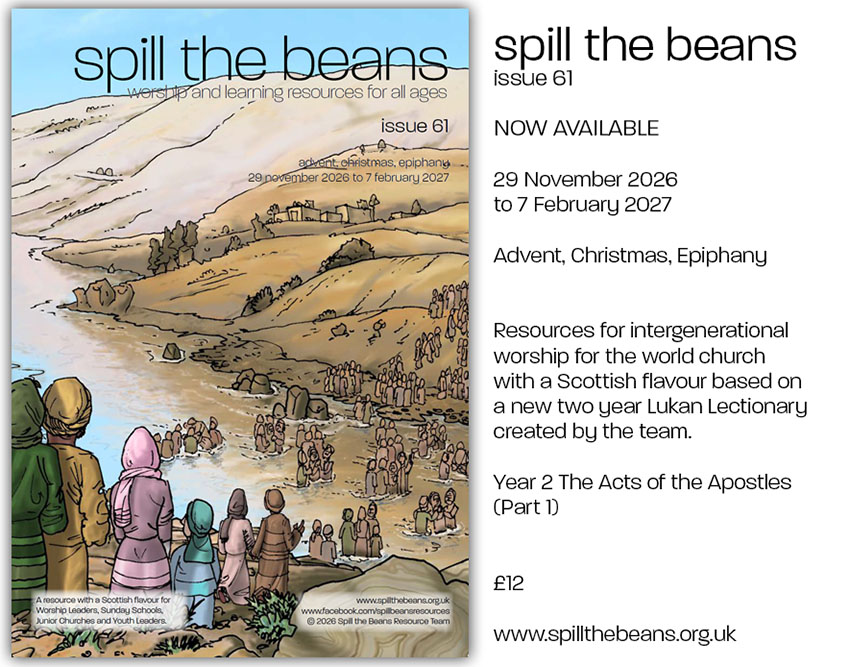
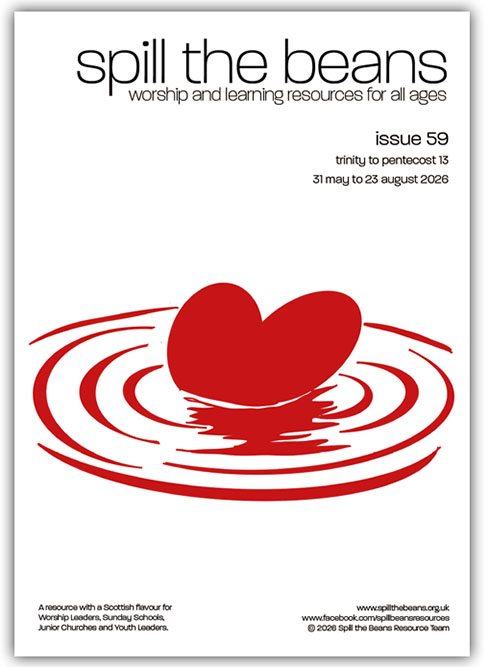
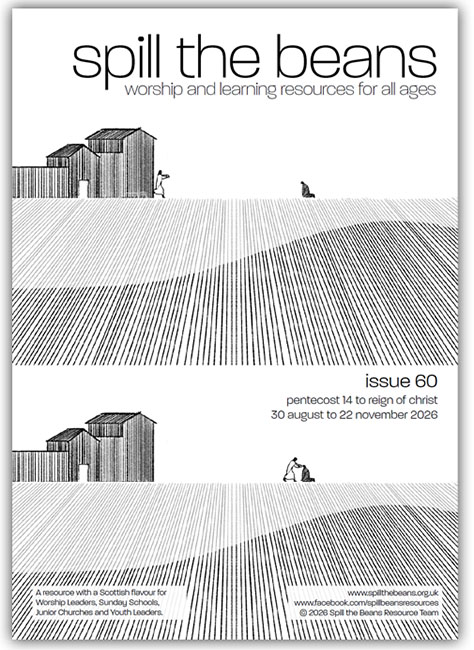
At last, the next mammoth issue of Spill the Beans is ready. Apologies for the delay with this one. It has been a challenging start to the year with very little spare time to devote to getting the issue completed. But now it is available!
The Spill the Beans Resource Team is now working on a fresh two year cycle that we have developed ourselves. This is our Lukan Lectionary, covering the two volumes written by Saint Luke within the New Testament. In year one we cover Luke's Gospel and in year two we will journey through the Acts of the Apostles. We started this journey in Advent and this issue is now the second issue and covers Lent and Easter through to Pentecost Sunday.
A full plan of the readings is available here, extracted from Issue 57 (note we are making some small tweaks as we go!).
We continue to focus on how we worship intergenerationally within our church contexts. Each issue of Spill the Beans is organised by how we might use different resources to "tell the story", "explore the story", and "live the story". You will find a range of materials and ideas, and we challenge you to think creatively about how you use it and to think more intergenerationally.
You will find more about this approach in the Introduction section of the issue. Any feedback you want to offer will be most welcome. This is easily done on the Facebook page/group.
Sampler
If you have not used Spill the Beans before then please have a look at this sample.
Full Issue
If you'd like to download a full copy of Issue 58 for use in your church or personally, then click the 'Buy Now' button below. The cost is only £12 (GBP). You can make a secure payment via PayPal and then an email with secure link to the download should wing its way to you. Please note that you can only download the file using this link three times, so please make sure you save the file to your computer as soon as you have downloaded it. We recommend first downloading to a laptop or desktop computer before moving to phone/tablet.
Please follow the instructions carefully. The pdf file is approximately 5 MB so it may take a wee moment to download. Please be patient as your computer does so!
You can also get involved in feedback and discussion on the Spill the Beans website, where we try to put up weekly PowerPoint backgrounds too. There is also a facebook page in which we share ideas and we have introduced a new Facebook group which you can link to from the facebook page and which we hope will provide a place of mutual support, ideas and encouragement as we trek together through this new adventure.
Print Copies
The office is open once more and can provide printed copies (within the United Kingdom) for an additional cost (usually around £20 + P&P depending on the size of the issue). Note that we recommend using the electronic version to reduce environmental waste. Please contact Devana Parish Church Office at This email address is being protected from spambots. You need JavaScript enabled to view it..
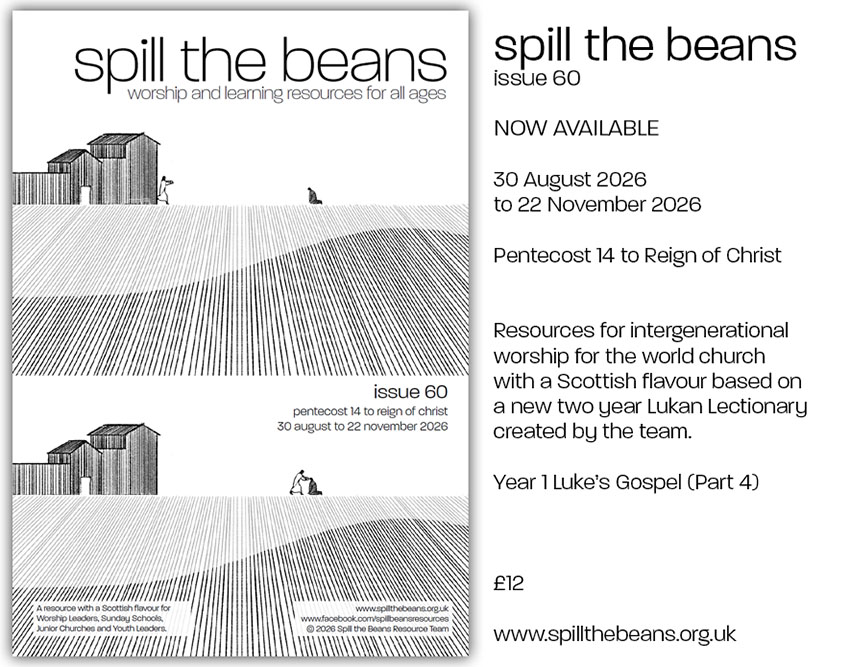
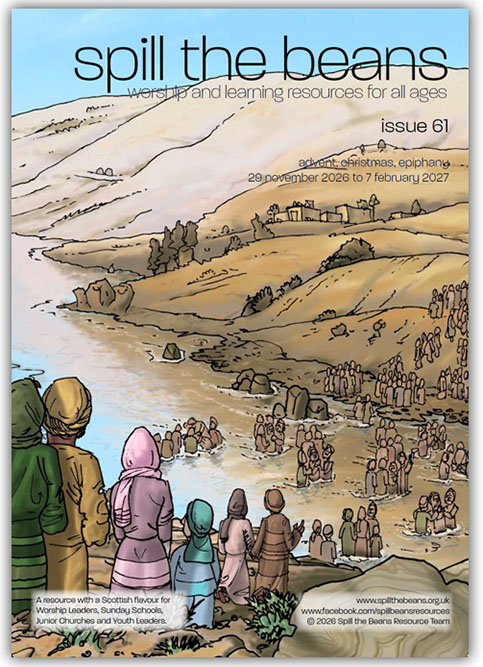
The Spill the Beans Resource Team embark on a fresh two year cycle, which we have been working on for the last year or so. This is our Lukan Lectionary, covering the two volumes written by Saint Luke within the New Testament. In year one we cover Luke's Gospel and in year two we will journey through the Acts of the Apostles. We start this journey in Advent and this issue is the first in this new cycle.
This has been a great journey over the last couple of years, but the team has been busy at work to create a new lectionary cycle for Advent 2025 through to the end of 2027. We are going to embark on a new two year cycle with Luke (both the Gospel and the Acts of the Apostles). A full plan of the readings is available here, extracted from Issue 57.
We continue to focus on how we worship intergenerationally within our church contexts. Each issue of Spill the Beans is organised by how we might use different resources to "tell the story", "explore the story", and "live the story". You will find a range of materials and ideas, and we challenge you to think creatively about how you use it and to think more intergenerationally.
You will find more about this approach in the Introduction section of the issue. Any feedback you want to offer will be most welcome. This is easily done on the Facebook page/group.
Sampler
If you have not used Spill the Beans before then please have a look at this sample.
Full Issue
If you'd like to download a full copy of Issue 57 for use in your church or personally, then click the 'Buy Now' button below. The cost is only £12 (GBP). You can make a secure payment via PayPal and then an email with secure link to the download should wing its way to you. Please note that you can only download the file using this link three times, so please make sure you save the file to your computer as soon as you have downloaded it. We recommend first downloading to a laptop or desktop computer before moving to phone/tablet.
Please follow the instructions carefully. The pdf file is approximately 5 MB so it may take a wee moment to download. Please be patient as your computer does so!
You can also get involved in feedback and discussion on the Spill the Beans website, where we try to put up weekly PowerPoint backgrounds too. There is also a facebook page in which we share ideas and we have introduced a new Facebook group which you can link to from the facebook page and which we hope will provide a place of mutual support, ideas and encouragement as we trek together through this new adventure.
Print Copies
The office is open once more and can provide printed copies (within the United Kingdom) for an additional cost (usually around £20 + P&P depending on the size of the issue). Note that we recommend using the electronic version to reduce environmental waste. Please contact Devana Parish Church Office at This email address is being protected from spambots. You need JavaScript enabled to view it..
At Devana, hope is central to who we consider ourselves to be. It is part of our 'slogan' borrowing from Saint Paul: "Journeying Together by Faith, in Hope, with Love." We try to take it seriously. But it can be hard amidst all that is going on in the world today.
Christian Aid has, in its 80th year, spent some time reflecting on a theology of hope in a very useful report prepared by Dr Nick Spencer and Bob Kikuyu. You can download a copy of the report here.
They write about the report:
This reflection presents a Christian theological expression on hope, marking 80 years of Christian Aid's mission. It acknowledges the harsh realities of the world today—conflicts, displacement, climate chaos, and shrinking democratic spaces—that can make hope seem distant. However, it stresses that hope must confront these realities honestly and be based on solid theological foundations that involve intention and determination grounded in the revelation of God through Jesus Christ and scripture.
The document critiques inadequate secular and theological reasons for hope, warning against confusing optimism with hope. It then proceeds to propose foundations for a Theology of Hope.
It's posited that Christianity offers a realistic, resilient hope that is neither naïve nor cheap. It trusts in the lawful nature of creation, affirms human agency and creativity, and recognises the power and challenges of human cooperation. This hope does not guarantee that the future will be better but insists that a better future is possible and worth working for. Christian Aid’s origins amid the devastation of the Second World War, and the subsequent impact it has had since then, encourages us to face the future with hope grounded in faith and action.
This email address is being protected from spambots. You need JavaScript enabled to view it. Tel: 01224 213093 (Fonthill Road) and 01224 961430 (Holburn Street)
Devana Parish Church
Fonthill Road Aberdeen, AB11 6UD and 539A Holburn Street Aberdeen, AB10 7LH
MORNING WORSHIP
10:30 a.m. please check here for site Holy Communion celebrated on First Sunday of the month